

The problem with a normal bend
When sheet metal is bent on a press brake the outside of the corner takes a radius roughly equal to the sheet thickness or more. On a 1.2 mm stainless panel that soft corner is visible, catches light unevenly and looks nothing like the crisp edge drawn by the designer.
What V-grooving does
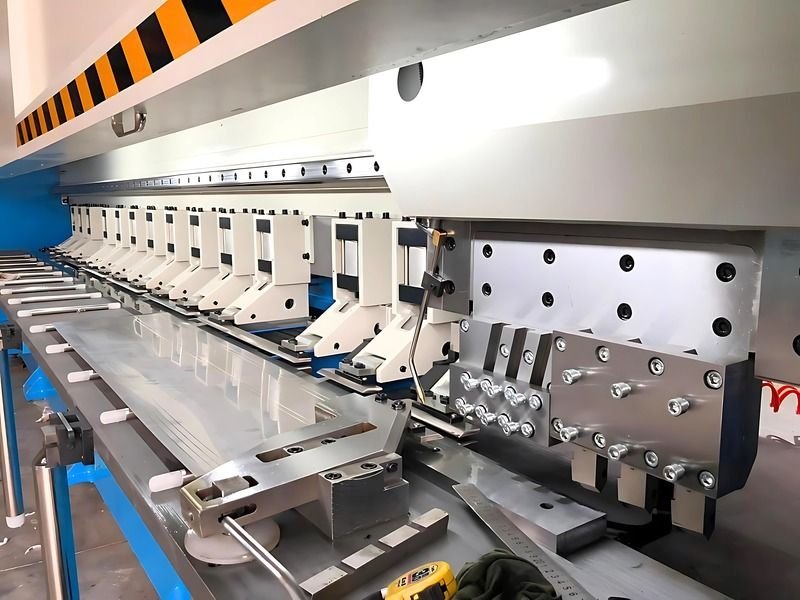
A CNC V-grooving machine cuts a precise V-shaped channel along the back of the sheet, leaving a thin web of metal. The sheet is then folded along that line: the web becomes the corner, and because most of the thickness has been removed the outside edge is sharp, with almost no radius. The groove is cut to a programmed depth and angle, so 90-degree, 135-degree and other folds are repeatable across a whole building.
Where it is used
- Column, wall and lift-lobby cladding with tight, straight edges.
- Door and window surrounds, skirtings and cornices in metal.
- Furniture skins, counter fronts and display plinths.
- Deep box profiles and signage letters with sharp returns.
Limits and good practice
- Sheet length: HOPE's machine handles sheets up to 4 m, so tall cladding can be one piece.
- Metals: stainless steel, brass, aluminium and mild steel; thickness typically 0.8 to 3 mm.
- Finish first: mirror, brushed or PVD finishes are applied before or after folding depending on the design; the corner is protected in transit.
- Backing: folded panels are bonded to a substrate or framed so the thin corner is never loaded.
Questions
Is a V-grooved corner strong?
It is a decorative edge, not a structural one. Panels are backed or framed so the corner carries no load; in service it is as durable as the rest of the panel.
Can PVD finish survive folding?
Yes for shallow folds; for mirror PVD panels we usually finish after folding to keep the colour uniform on the corner.
Do you offer V-grooving as a service?
Yes, for fabricators and designers: send a DXF or drawing and we cut, fold and finish the panels.